
An insight into women’s football
Women’s football has been around for as long as men’s has, but FIFA banned women’s football from being played professionally for 50 years from 1921 until 1971. After the ban was lifted, women could start playing football professionally, but had to restart everything.
The first official nationwide women’s league was formed in 1991, 20 years following the lift of the ban. It was named The Women’s Football Association (WFA) National League, and consisted of 8 founding teams, which included teams such as Doncaster Belles, Millwall Lionesses and Maidstone Tigresses (1986-1995). This league was later renamed as the Women’s Premier League in 1994 after the FA adopted it, and then was further changed to the Women’s Super League for the 2011 season.
A lot of popular football clubs had formed women’s teams earlier on, however Man United only properly formed their women’s team in 2018 after it was disbanded in 2005.
The surge in popularity for women’s football
After the England Lionesses won the Euros in 2022, participation for girls and women in football increased, with (according to FA) in 2015 only 2.5 million women and girls played football, but as of October 2025 this number had risen to 6,476,326.
With this rising success of women’s football comes the rise of development and grassroots opportunities for girls and women, which includes registered female football teams more than doubling by the 2023-24 season to over 12,150 teams.
Rise in funding and academy opportunities

Because of the rise in interest and popularity in women’s football, The FA established over 60 Girls’ Emerging Talent Centres (ETCs) which are supported by the Premier League This is to provide accessible, high-quality training, with plans to expand this network to increase the player pool.
Ben Wynne, an academy goalkeeping coach who has worked previously for Liverpool FC and Wrexham, said: “there’s been more intake of girls wanting to play football. A lot more parents and coaches are seeing that.
“Full time work is being produced and made available in girl’s football. Full-time programs are becoming available, for example Wrexham are looking to go full time with the women’s team.
“There’s also more girls’ only sessions, and more girls’ clubs. Even local academies which have been predominantly for boys are now setting up a girl’s section.”
Gap between men’s and women’s
Despite the investment from clubs and from the rise of interest in women’s football, there is still a massive gap.
The FA reported that for every female student playing football there are 13 male students participating.
There is a gap in funding for youth pathways for both genders too, with central investment into men’s academies from the Premier League being approximately £88m a year, whereas the FA only provide £3.25m per year for women academies.
Ben Wynne said: “There is evidently a gap between the boy’s section and girls’ section. The boys are a lot more well-supported financially and a lot more investment. The gap has gone smaller but there is still work to be done.”
A study from the Women’s Sports Trust highlighted that the average WSL attendance over the first six match rounds has been 6,500, and more than one-third of ticket sales in the league are from Arsenal.
The 6,500 average attendance for the WSL is not high compared to the average men’s attendance in the Premier League which is 40,421.
The second division for the Women’s Super League also only ranks in on average an attendance of 1,393.
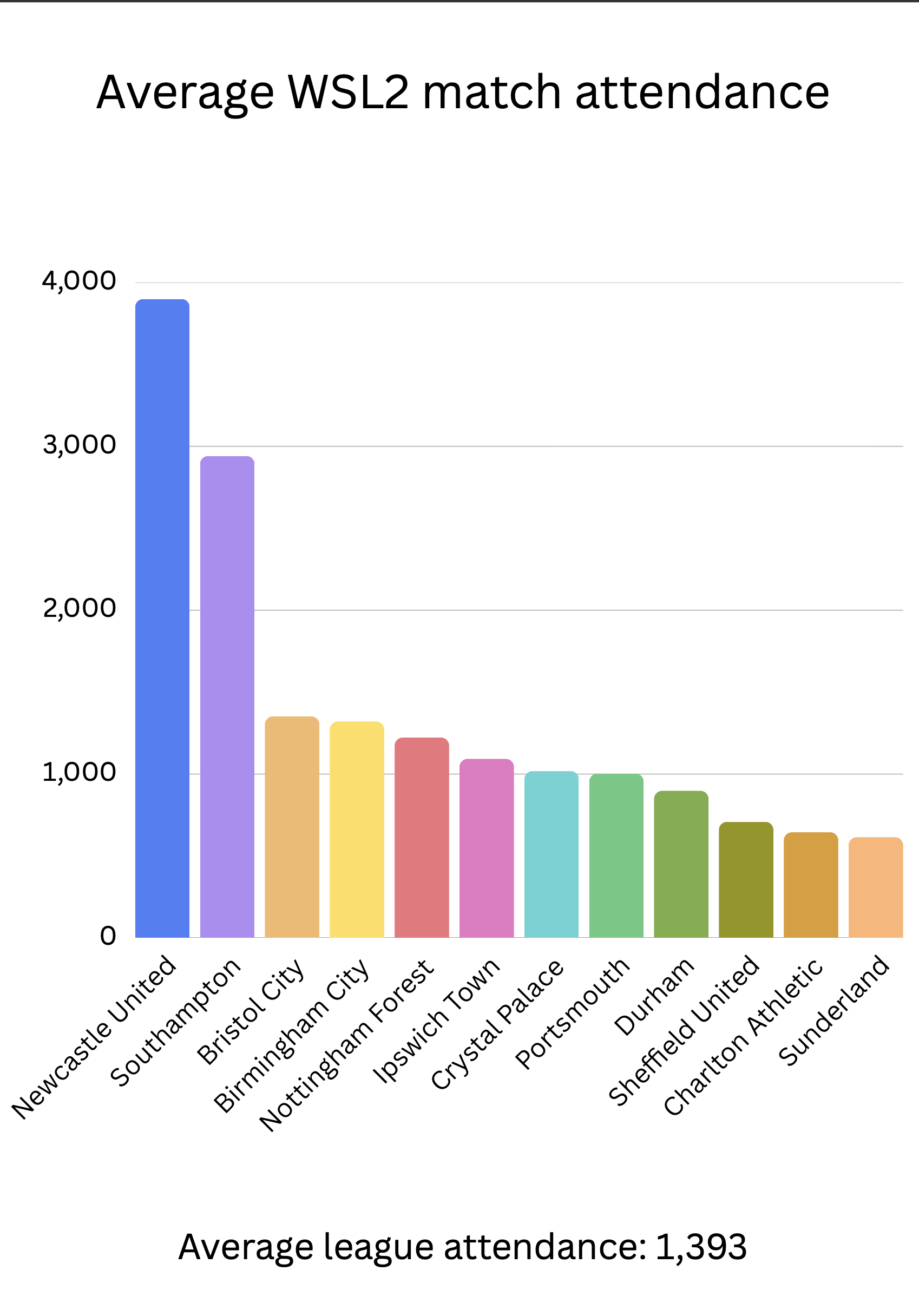
(Data by https://wsl2footballnews.co.uk/wsl2-attendance-numbers/
Ben also added: “How much coverage the men get compared to the girls contributes towards the gap.”
Next steps for women’s football
Jonathan Craig, Sunderland Women’s goalkeeping coach, has said: “I feel in my time working in women’s football I have seen the game grow with more professional teams/players and the technical ability of all players increase along with their physical profile. In 10 years’, time I would like to see every club playing at the men’s main stadiums and for the crowds to get bigger. Having home-grown players getting a chance would be great too”.

Broadcasting women’s football is another step towards helping improve club exposure. Woen’s football is available to watch on various platforms, including Sky Sports (who broadcast 90% of all lie WSL games) and you can also watch the Women’s Champions League games on Disney Plus.

Criticism within women’s football
Since women’s football has become more popular, there is no doubt that there has been a lot of criticism comparing men’s and women’s football.
Joey Barton, a former football player for Man City and Newcastle, has been known to post ‘controversial’ comments about women’s football. One of these comments was:
“I’d score 100 out of 100 penalties against Mary Earps. Any day of the week”.
However, other public figures have praised and backed women’s football. When the England lionesses won the euros in 2022, Gary Neville hailed it as a game-changing moment, not just for England football teams, but for women’s sport in general”.
This shows that the divide in opinion over the women’s game.
